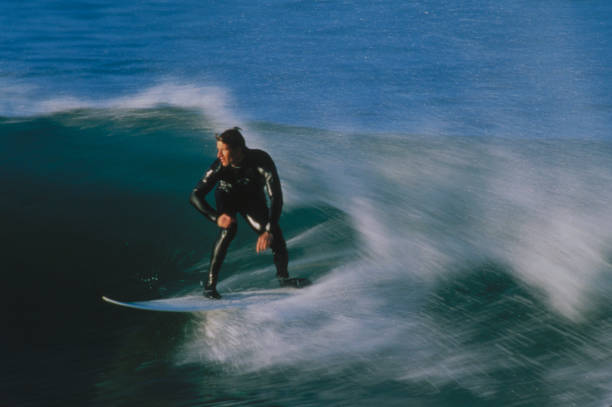
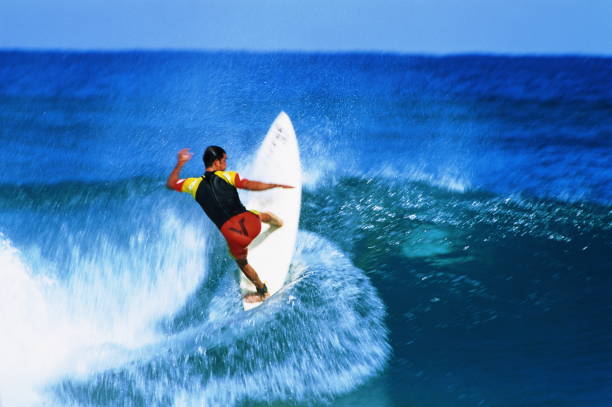
In the pantheon of surf gods, where power hounds and aerial assassins get their due, there exists a quieter throne. It’s reserved for the purist, the soul surfer whose impact is measured not in decibels but in a subtle, seismic shift in how we all see a wave. That throne belongs to Tom Curren. To talk about Curren is to talk about style—not as an add-on, but as the very essence of performance. In an era that was starting to shout, he was a whispered poem, a lesson in economy and flow that changed surfing forever.
Coming out of Santa Barbara in the early ‘80s, the surf world was a different beast. It was louder, more punk rock, with a burgeoning pro tour focused on radical, off-the-lip aggression. Then this kid shows up. He didn’t look like he was fighting the wave; it looked like he was having a conversation with it. His stance was a study in relaxed precision—knees bent, back arm low, a gaze that seemed to see three sections ahead. He didn’t just do turns; he drew them. His bottom turn wasn’t just a setup move; it was a deep, rail-grabbing sweep that generated impossible speed, the launchpad for everything that followed. That’s the Curren magic: every movement connected, nothing wasted, a continuous line of energy from rail to rail.
His approach was pure feel. While others were hammering the lip, Curren was playing the whole wave face like a musician. He’d drop into a cavernous tube at Pipeline with the same unhurried calm he’d apply to a four-foot runner at Rincon. He’d stall, speed up, throw a spray-less check-turn, and then unleash a carving cutback so deep and committed it seemed to defy physics. This wasn’t about brute force; it was about leverage, timing, and an almost psychic connection to the water. He made the difficult look effortless, and in doing so, redefined what “high-performance” could mean. It wasn’t just about maneuvers; it was about how you linked them, the style you poured into every moment between the turns.
Off the board, the man matched the myth. He was the original enigmatic soul traveler. In the heart of the neon ‘80s surf boom, Curren was the antithesis—quiet, introspective, often elusive. He’d disappear for months, chasing swells off the grid, his surfing fueled by a genuine love for the search, not the spotlight. This authenticity cemented his legend. He wasn’t a marketing creation; he was the real deal, a surfer’s surfer who let his riding do all the talking. His famous rivalry with Aussie powerhouse Mark Occhilupo in the late ‘80s and early ‘90s was the ultimate clash of styles: Occy’s raw power versus Curren’s sublime flow. It was a golden age, and Curren, with his three world titles, stood at its cool, collected center.
Today, the influence of Tom Curren is everywhere you look. That emphasis on rail-game, on flow over force, on making it look easy? That’s the Curren doctrine. Modern high-performance surfing, for all its aerial pyrotechnics, still rests on the foundation of power and flow he perfected. When you see a surfer link turns with a silent, carving grace, you’re seeing a bit of Curren. He taught a generation that style isn’t separate from performance; it is performance.
So next time you’re out, think about the line you’re drawing. Think about economy of movement. Don’t just smash the lip; feel the wave, connect the sections, and pour a little soul into it. That’s the timeless lesson from the Smooth Style Master. Tom Curren didn’t just win contests; he gave surfing a new vocabulary of cool, and for that, his throne in the lineup is forever reserved.