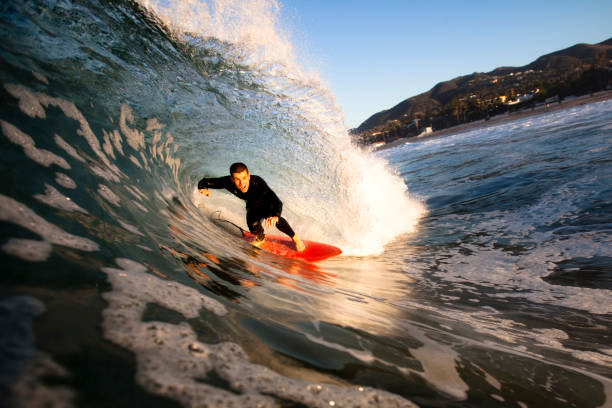
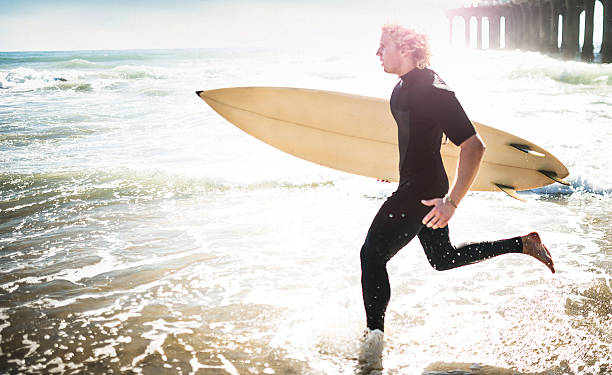
You hear it yelled from the beach, barked from the lip, and casually dropped in surf shop conversations. “Did you see her shred that section?“ “Man, he was absolutely shredding out there!“ It’s one of those core surf terms that sounds exactly like what it is: aggressive, fast, and powerful. But shredding isn’t just a fancy word for surfing. It’s a specific state of being on a wave, a commitment to attack, and the ultimate expression of controlled power.
At its heart, to shred a wave is to surf it with maximum speed, radical maneuvers, and pure aggression. It’s not a casual glide or a soul arch. Think less smooth cruising and more about laying down deep, carving turns, throwing buckets of spray, and attacking every section of the wave as if it personally offended you. When someone is shredding, they’re not just riding the wave; they’re dominating it. The board becomes an extension of their will, digging rail so hard it might as well be starting a fire, projecting down the line with purpose, and snapping off the top with enough force to make the lip weep. It’s performance surfing in its purest, most energized form.
The gear for shredding is typically a shortboard—a thruster, quad, or even a high-performance fish. You need a board that can pivot on a dime, hold a rail in a steep pocket, and generate speed out of pure muscle and wave dynamics. This isn’t the realm of the big, single-fin log. Shredding demands equipment that responds instantly to every subtle shift in weight and pressure. You’re driving a sports car, not a vintage cruiser, and the wave is your racetrack.
The mindset is everything. Shredding requires a kind of joyful aggression. There’s a fearlessness to it. It’s about committing to a turn even when you know you’re going to get a mouthful of foam, about pushing for one more hit on the close-out section, about generating speed where there seems to be none. It’s not reckless, though. The best shredders have this insane control within the chaos. They’re calculating the wave’s energy, setting up for the next section, and using power to create more power. It’s a physical chess game played at full throttle.
You’ll know it when you see it. The telltale sign is the spray. A surfer who is truly shredding isn’t just making a little splash. They’re throwing “rooster tails” off the tail and “curtains” of spray so thick you could hide behind them. The sound of a rail burying at high speed, the sudden acceleration out of a bottom turn, the explosive rebound off the lip—it’s a symphony of force. They’re not avoiding the whitewater; they’re using it as a ramp. They’re not fading from the pocket; they’re digging deeper into it.
In the end, shredding is about passion. It’s the physical manifestation of stoke turned into kinetic energy. It’s that feeling when everything clicks—your board, the wave, your fitness, your headspace—and you transition from riding a wave to attacking it. It’s tiring, it’s demanding, and it doesn’t always end with a clean exit. Sometimes you get swallowed whole by the wave you were just dissecting. But that’s part of the deal. Because for that one wave, that one ride where you link it all together with power and precision, you understand what it’s all about. You’re not just a surfer; you’re a shredder. And that, brother, is a feeling worth chasing from coast to coast, sunup to sundown. Now get out there and throw some spray.