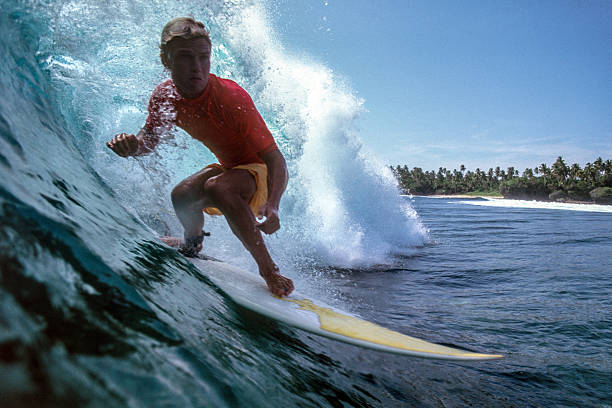
When you talk about the art of tube riding, about drawing a high line and getting deep, there’s one name that stands as the absolute benchmark: Shaun Tomson. In the mid-70s, when competitive surfing was finding its feet and performance was about to explode, Tomson didn’t just ride waves; he redefined what was possible inside them. He was the original tube master, the guy who made getting pitted not just an act of survival, but a thing of pure, stylish power.
Hailing from Durban, South Africa, Tomson came from a surfing family and had the ocean in his blood. But it was at a right-hand point break called Jeffreys Bay where his legend truly began to take shape. While others were focused on radical turns off the top, Tomson had a different vision. He saw the tube not as a closing-out section to avoid, but as a canvas. His approach was simple but revolutionary: take off later and deeper, set a high line right under the pitching lip, and stall with his weight on the back foot to let the curtain envelop him. Then, with a subtle shift forward, he’d drive out, often with a casual touch on the wall, as if to say, “Yeah, I meant to do that.” This wasn’t luck; it was a calculated technique, and it changed everything.
His equipment was key. Riding for Channel Islands, Tomson helped develop and then master the “channel-bottom” twin-fin. Those channels, those grooves running down the board, gave it incredible hold in the critical part of the wave. It was the perfect tool for his high-line, tube-centric approach. The board held where others would slip out, allowing him to maintain speed and control while completely covered. It was a perfect marriage of surfer and shape, and it dominated.
In 1977, Tomson took this approach to the world stage and absolutely owned it. He won the world title, not with flashy aerials (they didn’t exist yet), but with an unmatched mastery of the tube and an uncanny ability to find the exit where no one else could. He made tube riding the ultimate expression of performance surfing. Watch any footage from that era, and it’s clear: while others are scrambling, Tomson is composed. He’s in the green room, perfectly positioned, totally at home. He brought a sense of calm, powerful intentionality to the most intense part of the wave.
But Tomson’s impact goes way beyond a trophy or a specific maneuver. He brought a mindset. He showed that true performance wasn’t just about aggression; it was about flow, timing, and a deep connection with the wave’s energy. He made style inside the tube paramount. That influence echoes in every surfer today who would rather get a deep, clean tube than throw ten spray-heavy turns. He’s the spiritual godfather to every goofy-footer at Pipeline and every regular-footer at Cloudbreak who lives for that moment of silence inside the roar.
Off the wave, the man carried himself with the same quiet confidence. He was, and is, a thoughtful ambassador for the sport. His later years have been marked by profound personal tragedy, but also by a powerful message of resilience and hope, shared through his book and talks. It’s the same core principle he applied in the tube: face the power with focus, and find a way through.
So next time you paddle out, and you see a set throwing a heaving lip, think of Shaun Tomson. When you take off late, set that high line, and feel the tube wrap around you, you’re walking a path he carved. He was the pioneer who showed us that the ultimate ride isn’t just on the wave, but in it. And that legacy is forever stoked into the soul of surfing.