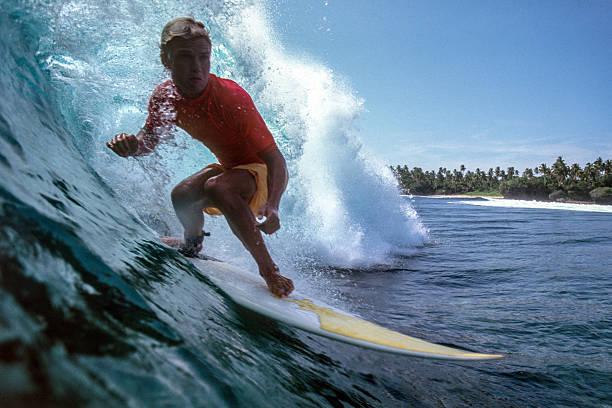
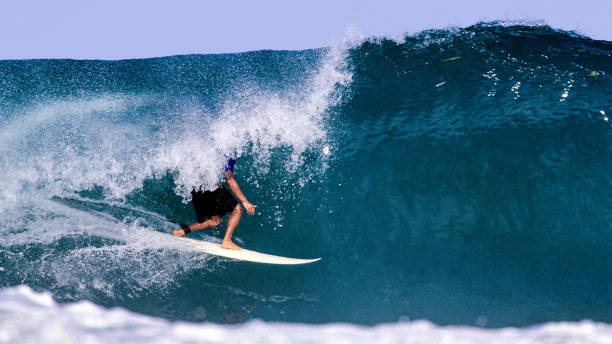
If you’ve spent any time around surf culture, from the lineups of Waimea to the stickers on a beater van, you’ve seen the phrase: Eddie Would Go. It’s three simple words, but they carry the weight of the Pacific. It’s not just a cool slogan; it’s the soul of big-wave surfing, a mantra, and a deep cultural touchstone. To understand what it really means, you gotta know the story, feel the aloha, and see the code within the words.
The “Eddie” is Eddie Aikau, a legendary Hawaiian waterman. In the 60s and 70s, Eddie was the first official lifeguard at Waimea Bay on Oahu’s North Shore. On days when the surf was pumping—I’m talking 20, 30, even 40-foot faces—and everyone else was either watching in awe or shaking in their booties, Eddie would paddle out. Not for glory, but for duty. He made over 500 rescues in his career, famously never losing a soul. He knew the Bay like his own backyard, reading its wild, chaotic energy with a preternatural calm. When it was giant, closing out, and everyone said it was impossible, Eddie would grab his red board and go. That’s the origin story: pure, unwavering courage in the face of nature’s raw power.
But “Eddie Would Go” transcends that historical fact. It’s not a reckless command to charge every close-out or take off on every death-defying bomb. That’s a kook’s interpretation. The real meaning is layered, like the reef at Pipeline.
First, it’s about readiness and responsibility. Eddie didn’t just “go” on a whim. He went because he had the skill, the knowledge, and the conditioning. He spent a lifetime building his relationship with the ocean. “Eddie Would Go” means putting in the work—the dawn patrols, the hold-downs, the respect for the sea—so that when the moment calls, you can go. It’s about being the most capable version of yourself in the water.
Second, it’s about selflessness and aloha. Eddie went for others. His courage was in service of his community. In that spirit, the phrase is a reminder to watch your fellow surfers’ backs. It’s about being the one to help a buddy in a tricky situation, to share a wave, to spread the stoke rather than the agro. It’s the opposite of a selfish, drop-in mentality. It’s the waterman’s code: the ocean is for everyone, and we look out for each other.
Today, the phrase finds its purest expression in The Eddie—the Quiksilver in Memory of Eddie Aikau big-wave invitational. It’s the most prestigious and spiritual contest in surfing, but it only runs when Waimea Bay reaches a consistent minimum of 20-foot Hawaiian (meaning 40-foot faces). They’ve only held it a handful of times since the 80s because the conditions have to be perfect—not just huge, but Eddie-huge. The invitees are the world’s most elite big-wave chargers, but winning isn’t really the point. Participating is. Paddling out on a “Go” day is to honor the man’s legacy directly, to whisper “Eddie would go” to yourself as you commit to a mountain of moving water.
Beyond the surf, the phrase has bled into everyday life. It’s become a shorthand for stepping up when things get heavy. Got a big project at work that seems overwhelming? Eddie would go. Need to have a tough conversation? Eddie would go. It’s about confronting challenges with a calm heart and a prepared mind, not with blind bravado.
So, next time you see those words, remember it’s more than a tribute to a hero—though it is that, deeply. It’s a blueprint for how to surf and how to live. It’s about earning your place, respecting the power of nature, helping your community, and when the real moment comes—not the imagined one, but the true, calling moment—finding that quiet courage to paddle over the ledge and commit. Because in the end, “Eddie Would Go” is a question we ask ourselves: Are you ready, in every way, to go? If you’ve lived by the code, the answer will already be there. Mahalo, Eddie. Your legacy is forever in the set waves.