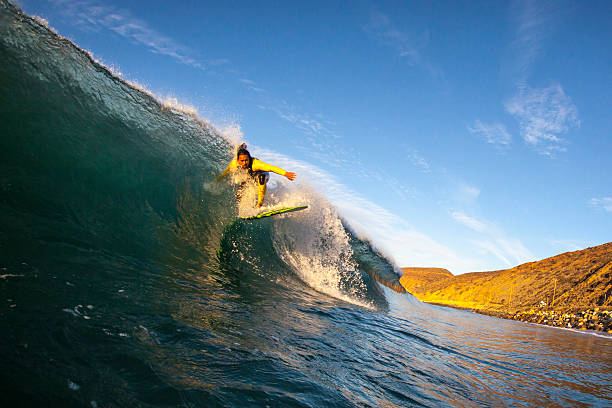
There’s a certain kind of wave that needs no introduction—the kind that peels perfectly down a sandbar or punches a hollow left on a reef, glassy and clean. And then there’s a certain kind of surfer who needs no soundtrack, no hooting, no dramatic paddle battle. Tom Curren is that surfer. For those who grew up watching grainy VHS tapes or catching flashes of his runs at Pipeline, Curren wasn’t just a three-time world champion. He was a lesson in physics, a study in restraint, a quiet storm that turned the act of surfing into something closer to poetry. His smooth style didn’t just win heats; it changed how the whole lineup thought about moving on a wave.
When you watch old footage of Curren at Bells or at his home breaks around Santa Barbara, you notice the absence of fuss. No frantic wiggles, no over-cranked snaps. Instead, he flows like water itself. He sets a rail deep in the pocket, lets the board find the natural arc, and then drifts through a bottom turn with a kind of unhurried elegance. The carves are so drawn out that they feel inevitable. The cutbacks are not sudden slashes but long, sweeping re-directions that rebound off the face with a liquid fluidity. It’s the opposite of the aerial, vertical style that came later. Curren proved that power and grace are not opposites but partners. He pumped with his entire body through the toe side, then cross-stepped his way to the nose and glided with a trim that looked like he was standing on a skateboard in a dream.
That smoothness was never accidental. Curren studied waves like a surfer-scientist, reading the seams and the shadows where energy built. He knew that speed isn’t chased; it’s cultivated. So he chose lines that kept him in the vortex, weaving around the foam ball not with desperation but with a stalling, tilting dance that kept his board humming. His backside surfing at reef breaks like Deserts or the World Tour stops in France became legendary. He didn’t just ride the wave; he inhabited it. The same way certain musicians can bend a note and make time feel thicker, Curren could bend a bottom turn and make the wave’s power feel like his own. Whether he was tucking into a grinding barrel at Chopes or laying down an extended rail on a hollow right at Rincon, his body moved in one continuous flow—no wasted motion, no forced aggression. That unbroken rhythm is what separates a smooth surfer from a merely talented one.
But the true impact of Tom Curren lies beyond his trophies. He carried a different philosophy into the water, one that prioritized expression over victory. In an era of aggressive, almost robotic surfing, he was the renegade who would blow off a heat to find a clean, unridden peak. His interviews were mumbles. His presence was a shrug. Yet his surfing spoke with a clarity that shattered any need for hype. Every kid who grew up watching him tried to mimic that flowing, low-riding style. Some came close. None matched the pure organic quality. He had a way of making the most critical section seem like a casual playground, and a flat section seem like a canvas for cross-stepping magic.
What Curren gifted to surf culture is the idea that you don’t need to stomp, slash, or gouge to leave a mark. You can simply find a glide. He showed that the most radical maneuver is a perfectly timed fade, or a deep, drawn-out rail carve that takes you through the entire length of a crumbling section. He made it okay to be smooth when everything else was loud. His legacy is why so many modern free surfers still chase the “finesse factor,“ why boards get shaped with fuller rails, and why a single, soulful turn can still make a whole lineup pause and turn their heads. The search for perfect flow, the soul-arch bottom turns, the feet that barely shuffle yet somehow find the nose at just the right moment—all of that traces back to Tommy Curren’s quiet revolution.
Tom Curren’s style was a force of nature disguised as a chill. He didn’t fight the wave. He danced with it. And in doing so, he taught generations that surfing is not a battle against the ocean but a conversation between a person, a board, and the moving water. That conversation, when done right, has a rhythm. Curren’s rhythm was slow, magnetic, endless. It still is. Whether you’re a grom at your local beach or a seasoned ripper on a slab, the lesson remains the same: smooth is not soft. Smooth is the mastery of every micro-movement, the way a breeze shapes a dune or a river cuts a canyon. That is the quiet power of Tom Curren, and it’s still humming through every graceful cutback and flowy frontside carve you see today.