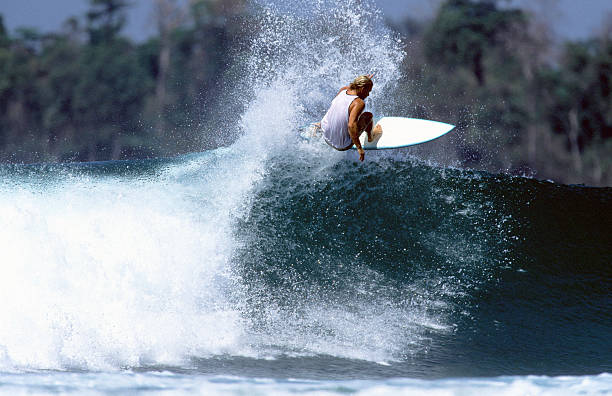
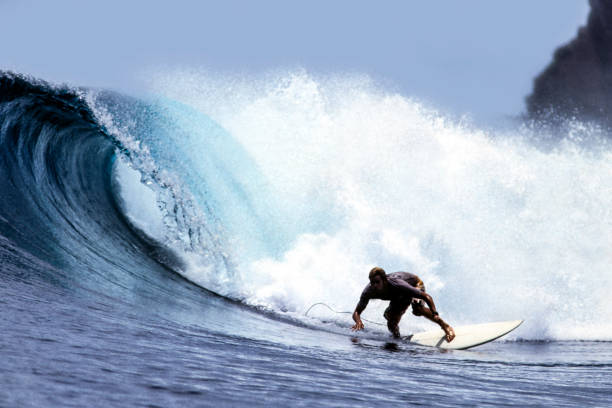
Somewhere between the last longboard rumbles of the mid-sixties and the first full-throttle hiss of the shortboard era, a weird, wedge-shaped little board started showing up in the lineups of Australia’s east coast. It didn’t look like anything the crew had ever ridden. That nose was pulled in tight, the tail kicked up, and the bottom of the hull had this bizarre ridge running down the middle—like the keel of a surfboat. The old boys called it a trick, a gimmick. But the young rippers who got their hands on one? They were suddenly flying. They were stalling cliffs of water that would have bogged a nine-footer, pulling turns that seemed to defy the laws of friction. What had happened? The V-bottom had arrived, and with it, the shortboard revolution really started to breathe fire.
To understand why the V-bottom mattered so much, you have to feel what a longboard felt like in those glassy, overhead point breaks. You’d paddle in, take off on that huge, forgiving rocker, and then just trim—rail down, nose out, letting the board run on its flat belly like a sled. Bottom turns were long, sweeping arcs because the entire length of the board was engaged. Turning meant lifting your whole body, weighting the inside rail, and hoping the foam didn’t grab hold and pitch you over the falls. Then someone like Bob McTavish, who was already playing with shorter outlines, started chopping out the rocker and experimenting with a concave and a V. The V-bottom was a wild card: that central ridge acted like a spine. On a flat, rail-to-rail bottom, the board has a huge contact patch, and the water has nowhere to go. With a V, the water splits and spills off each side. That meant less drag, more speed, and a completely different kind of turning. Instead of sliding around a pivot point near your front foot, the V allowed the board to pivot from a point right under your back foot. You could stall, snap, and throw spray like a knife through butter.
George Greenough, a Californian living in Australia, had already been building these little kneeboards with V-bottoms and flexible, stingray-like fins. He was the mad prophet. He’d lie prone, strapped in, and ride inside the tube with his cheek almost touching the face of the wave. His board was short—under six feet—and it had that deep V that let him carve impossibly steep arcs. The shortboard guys looked at what Greenough was doing and realized the future wasn’t about riding more board. It was about riding the wave’s energy, not just its surface. So McTavish, Nat Young, and a handful of sharp shapers like Ross McKercher started thinning out the foils, dropping the rails, and putting a more pronounced V into their new, shorter boards. The result was a board you could bury in the pocket. You could load up that back foot and feel the V bite into the water, then release with a snap. The classic longboard turn was a smooth, drawn-out glide. The new V-bottom turn was a violent, explosive pivot that came out of nowhere. Surfing went from cruising to attacking.
There were problems, of course. The early V-bottoms were twitchy. They’d slip out on flat sections if you weren’t on your A-game. They wanted speed, and they wanted your commitment. But that trade—trading stability for acceleration—was exactly what the revolution was all about. The shortboard didn’t just make surfing harder; it made surfing faster. It let you get to a part of the wave that longboarders could only dream about—the green, hollow, spitting section where the lip throws over. With a V, you could sit high, drop in late, and then use that rail-to-rail release to shoot down the line like a bottle rocket. It changed how surfers read waves. Instead of looking for the big, open face, you started looking for the pocket, the curl, the part of the wave that had the most tension.
What’s crazy is that the V-bottom didn’t last long in its pure form. Shapers soon realized that a slight vee through the tail combined with a flatter entry or a subtle concave could do even more. The V evolved, blended, and eventually became one of the many tools in the quiver of modern surfboard design. But its moment in the late sixties was nothing short of seismic. It broke the mold, proved that shorter boards could actually be faster, and gave the sport a new language of turning—bottom turns, off-the-lips, and that holy grail, the tube ride. Every modern high-performance shortboard owes a debt to that weird, ridged bottom shape that showed up unannounced and changed everything. The V-bottom was the first real taste of the endless summer’s darker, speed-lusting side. And once surfers got a taste, they never went back to trim. They went deep.