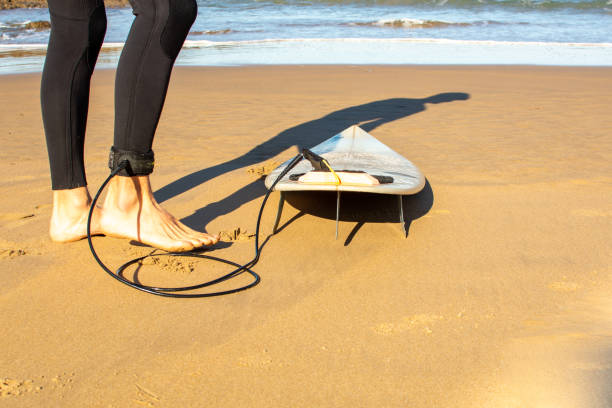
You paddle out at dawn, the ocean glassy and waiting, a set on the horizon that looks like a promise. You’ve waxed your stick. You’ve tied your leash. That last part, the leash, is probably the most overlooked piece of essential surf gear beyond the board itself. We spend hours obsessing over fin templates, rocker curves, and resin tints, but that thin, urethane cord connecting your ankle to the tail is the only real safety net between a long, cold swim and a perfect session. It is, without a doubt, the unsung hero of your quiver.
Let’s talk about the first time you ever bought a leash. You probably grabbed the cheapest, thickest thing on the rack at the surf shop, not knowing any better. It felt rugged, like a tow rope. That’s the old-school mindset, a hangover from the days before leashes were even a thing, back when losing your board meant a swim to the beach and a long walk back, or worse, a cracked skull. The leash was invented out of necessity, a genius move by Pat O’Neill in the early ’70s to keep his dad’s wetsuit company afloat, and it revolutionized the sport. But just having one isn’t enough. Understanding the soul of your leash is part of mastering the waves.
The most critical factor is safety. A good leash keeps your board from becoming a missile in the whitewater. When you wipe out, that board is a 6, 7, or 8-foot slab of foam and fiberglass with sharp fins. In a crowded lineup, a loose board can do real damage, what we call “trading paint” but with skin and bone. Your leash is the leash that holds that beast back, preventing a kook who just got pitched from his foamie from taking out you or a local legend. It’s the ultimate piece of lineup etiquette, a sign that you respect the ocean and everyone in it. Without it, you’re a hazard.
But the real relationship with a leash goes deeper than safety. It’s about flow. Think about the last time you had a leash snap on you. It’s a gut-wrenching feeling. You’re underwater, tumbling, and you feel the sudden slack. The board is gone. You surface, gasping, and see it already fifty yards away, heading for the rocks or the next county over. The panic is real. A quality leash, properly attached, never gives you that panic. It lets you commit to a critical bottom turn, charging straight down the face of a steep wave, knowing that if you slip, you’re not going to lose your ride. You can bail with confidence, knowing you’ll pop up right next to your board, not a hundred yards down the beach.
There’s a specific kind of trust that builds between a surfer and their leash. You learn to feel it. The slight tug when you’re paddling against a current, the way it straightens out when you’re riding down the line, the distinct whip sound when you kick out and the board flips. You learn what a good wrap feels like around your ankle, not too tight to cut off circulation, not so loose it slips off. The cord material matters. Braided polyurethane is the standard for a reason, it stretches just enough to absorb the energy of a snap, preventing the rail of the board from slamming into your head. Ten-millimeter is standard for everyday surfing. Thinner, six-millimeter leashes are for small waves or performance where you want less drag, but you’re trading safety for speed. Thicker is for heavy water and big waves, where the force of a hold-down is astronomical.
And let’s not forget the rail saver. That little piece of Velcro-covered fabric that wraps around your stringer is not optional. It’s the thing that stops the leash string from sawing through the resin and glass of your tail. I’ve seen more dings from a leash rope pulling through the glass job than from any rock. You take care of your leash, rinse it with fresh water after every session, keep it out of the sun, and it will take care of you. A cracked, dry, brittle leash is a ticking time bomb. Replace it once a year, or the moment you see a nick in the cord.
In the end, that little cord is more than a safety device. It’s a connection. It’s the invisible hand that keeps you tethered to your joy, your equipment, and the lineup. When you’re out there, deep in a barrel, the world is a churning, chaotic tube of perfection. The only thing that connects you to the surface, to your family on the beach, to your car keys, is that leash. It’s the link between the surfer, the stick, and the endless summer. Don’t treat it like an afterthought. Treat it like the essential gear it truly is.