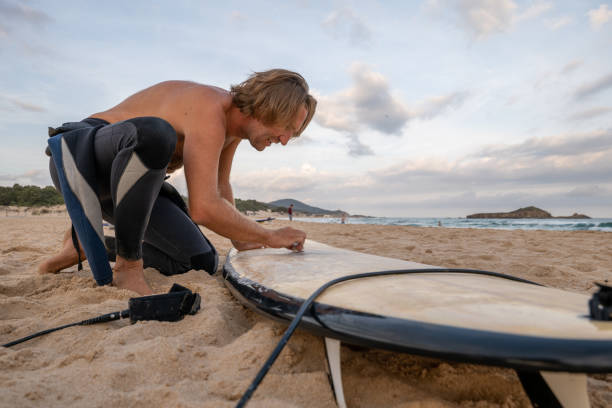
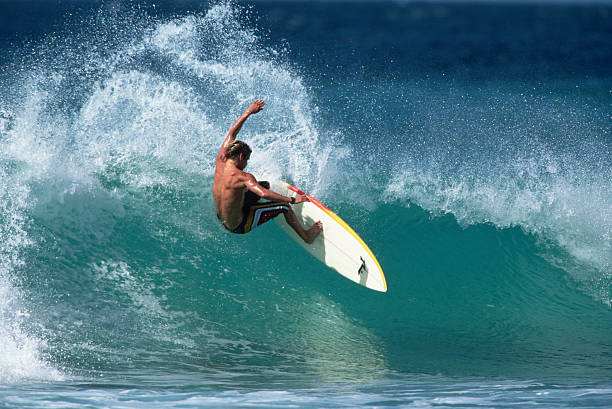
You paddle out on a glassy morning, the ocean a sheet of liquid mercury under a low sun, and you feel that familiar hum through your board. That hum is your fins talking to the water, and if you are really dialed in, you can hear exactly what they are saying. Most of us spend our days on thruster setups or four-fin quads, chasing the perfect balance of drive and release. But sometimes, the best way to go forward is to look way, way back. There is a piece of surfing history that still messes with the heads of shapers and chargers alike, a little slab of fiberglass and resin that turned the whole concept of turning on its ear. That is the Greenough Stage 4, and it is the weirdest, most radical fin you have probably never ridden.
If you have ever wondered where the modern fin actually came from, you have to thank George Greenough. George was a California transplant who headed down to Australia in the sixties and started filming and shaping in a way nobody had ever seen. He was a genius, a madman, and an obsessive student of the wave. He did not just want to ride a wave; he wanted to become part of it, to feel the water rush through every rail and across every inch of the bottom. The equipment of his time was just not working for him. Those big, heavy, single-fin longboards were clunky. They would slide out on steep faces. They had a top speed that felt like a governor was on your engine. So George did what any self-respecting soul surfer would do. He built his own.
The Stage 4 is not a fin you just buy off the rack. It is a fin that you feel in your bones. It is a single fin, but it is no ordinary single fin. It is massive, with a huge base that sweeps forward and a heavily raked tip that gets narrow and thin. It looks almost like a dolphin’s dorsal fin, or maybe a sabretooth tiger’s tooth. It is glassed directly onto the board, usually on a Spoon or a similar deep-bottom, low-rockered vessel. The whole point of the Stage 4 is not to stabilize you. A normal fin fights against turn. It wants you to stay in a straight line. The Stage 4 does the exact opposite. It is designed to pivot. When you put the board on rail with a Stage 4, the fin flexes, it loads up like a spring, and then it releases all that energy in a tight, screaming carve that puts a grunt in your gut. You are not steering the board. You are asking it to dance, and it says yes.
The crazy thing is, most people hate the Stage 4 their first time. It feels squirrelly. It feels loose. You put your weight on your back foot in a steep section, expecting the fin to hold, and instead it just slides around like a cat on a hardwood floor. That is because you are used to a modern fin that does all the work for you. The Stage 4 makes you work. It demands you stay balanced right over the center of the board, with your weight flowing through your front foot. You have to trust the flex. You have to trust that when the fin bends, it is not going to break, it is going to catapult you through the turn. And when you do trust it, when you finally get that one wave where everything lines up, you understand what George was chasing. You get a hook that feels like the wave is turning with you, not away from you. The rail bites in, the board rolls onto its edge, and the scoop of the bottom combined with that big, flexible fin just locks you into the pocket with a sensation that is pure, raw power.
In the history of tuning your ride, the Stage 4 is the ultimate lesson in letting go of control to gain control. It is not the fin for a windy, choppy beach break. It is not the fin for mushy crumble. It is the fin for a clean, hollow point wave where you have the speed and the commitment to really drive it. It reminds us that the gear we use is not just about convenience. It is about connection. A thruster setup is comfortable and reliable; it is a sedan that gets you there. A Stage 4 is a vintage sports car with a manual transmission and no power steering. It is going to be a handful, it is going to be scary, and sometimes it is going to throw you off. But when you put it through a perfect arc on a perfect face, you understand why the legends of the sixties and seventies spent their whole lives chasing a flex pattern that felt like flying.
So next time you are staring at your quiver with a little bit of boredom, do not reach for the newest high-tech computer-cut plug system. Find a local shaper who knows the old ways. Get a proper hull or a modern reinterpretation of a Spoon. Glass on a Greenough Stage 4. Take it out on a good day. And let the fin teach you something you forgot. Because the wave is still the same. The water still knows how to dance. You just have to be tuned in enough to follow.