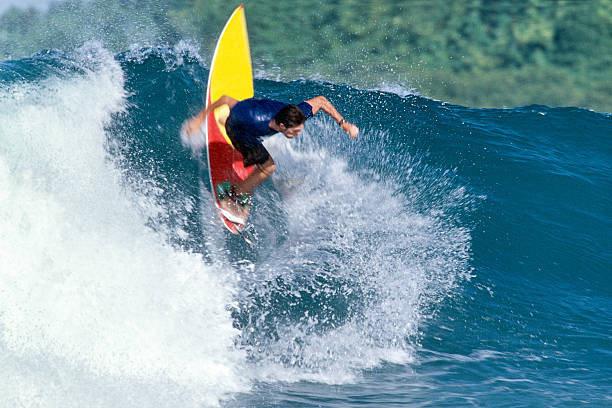
When you paddle out past the foam and sit in that lineup, the whole world kind of goes quiet except for the hum of the ocean and your own heartbeat. Every set that rolls through is a different story, and the story starts way before you even pop up. It starts with finding the peak. The peak isn’t just the highest part of the wave. It is the heart of the wave, the point where the swell first feels the bottom and begins to pitch or crumble. If you miss that spot by even a few feet, the whole ride changes. You might end up on the shoulder, chasing a wave that never really opens up. Or worse, you get caught inside with the lip slapping you like a wet towel.
Finding your takeoff zone is the difference between surfing a wave and being a passenger on one. The takeoff zone is that sweet spot where the wave is steep enough to give you a drop, but not so critical that you freefall into the flats with your eyes closed. It is the place where you can feel the energy of the water start to lift your board, and you know it is time to commit. For a mushy, slow wave, the peak is often soft and fat. It isn’t really pitching, just kind of rising up with a gentle slope. Your takeoff zone there is wide, almost forgiving. You can sit a little deeper, wait for the swell to push you, and then take a slow, drawn-out pop up. The trick is not to rush. Let the wave build underneath you. If you try to jam yourself into it too early, you’ll stall out and the wave will pass you by.
On the other end of the spectrum, you get an epic, hollow wave. The kind that reels off a reef or a sandbar with a perfect pitching lip. Here, the takeoff zone is tight. It is a very specific pocket. You need to be right under the peak, almost staring up at the wall of water as it stands up. A foot too far left and you’ll get clipped by the lip as it throws. A foot too far right and you’ll slide down the face without enough angle, getting caught in the wash. Reading that peak requires you to watch the horizon. You need to spot the lump forming. Watch the movement of the water as it pushes over the shallow spot. Experienced surfers call it watching the energy. The wave hasn’t even broken yet, but you can see where it wants to. That is your spot.
Getting comfortable with reading the peak comes from time in the water. There is no app or YouTube video that teaches you the exact takeoff zone for your local break. You have to feel it. You have to get your heart rate up a little when you see a set feathering a hundred yards out. You have to decide if you are going to paddle for the deep part or if you need to slide over onto the shoulder to maintain speed. On a point break with a long wall, the takeoff zone might be more forgiving because that wave just wants to peel forever. On a beach break with shifting peaks, you have to be ready to adjust every single wave. The peak might move ten feet between sets. That is why you see guys repositioning constantly, turning around to face the ocean, scooting a little left, a little right. They are hunting the peak.
There is also the matter of the lineup. You aren’t the only one out there looking for the peak. Surfing has a code, a kinda unwritten rule that whoever is closest to the peak usually gets the wave. That is priority. If you are sitting just behind the mass of the crowd, you need to be confident that you can read the peak better than the next guy. You might let a few waves go, just watching how they form, counting the sets. That is not being passive. That is gathering information. When you do finally pick a peak and commit, you need to paddle with everything you have. It is not a casual stroke. You have to match the speed of the wave. That is how you get into the takeoff zone cleanly.
Mastering the peak is what separates the surfers from the people floating around. It is about anticipation, focus, and a deep respect for the ocean’s rhythms. When you find that perfect takeoff zone, when you feel the board drop and the wave lift you, that is the stoke that keeps you coming back. It is the same feeling whether the wave is a mushy reform or a critical, epic barrel. It is you, the board, and that tiny golden spot on the face of the water. Everything else just falls away.