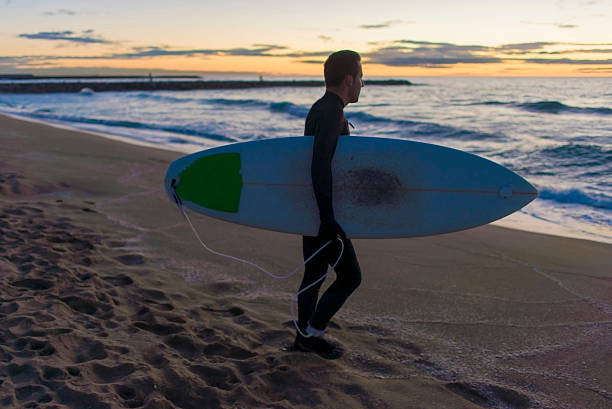
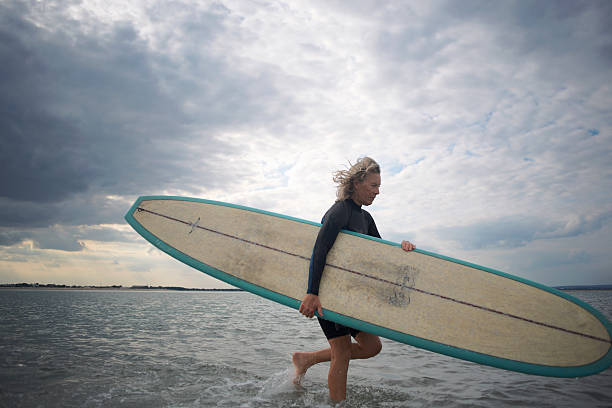
The story of the surfboard is the story of surfing itself. It’s a tale of shedding weight, embracing new ideas, and constantly chasing that perfect feeling of glide. If you’ve ever paddled out, you’re riding the cumulative genius of generations of shapers and dreamers who refused to accept that “good enough” was actually enough.
It all started, as the old stories go, with the ancient Polynesians. These were the original watermen, carving massive planks from local woods like koa and wiliwili. These olo and alaia boards were heavy, dense, and seriously challenging to ride. They were less about carving turns and more about the primal thrill of standing and sliding on the energy of the ocean. This was surfing in its purest, most elemental form.
Fast forward to the early 20th century, and the scene was dominated by the “plank.“ Think Duke Kahanamoku and the Waikiki Beach Boys riding solid redwood monsters, sometimes over 15 feet long and weighing a staggering 100 pounds. These boards were about grace and trim, but they were a nightmare to maneuver. Paddling one was a full-body workout, and turning? Forget about it. You basically went straight.
Then came the game-changer: the 1930s introduction of lightweight balsa wood from South America. Guys like Bob Simmons and later, legends like Dale Velzy and Hobie Alter, started laminating balsa with resin and fiberglass. This was the first major revolution. Suddenly, boards got lighter, stronger, and more accessible. The “Malibu” or “pig” shape emerged—wider, with a rounded nose and a square tail. This was the board that helped launch the 1950s and 60s surf explosion, allowing for those classic nose-rides and smoother turns. Surfing culture had its iconic tool.
But surfers are a restless bunch. The longboard’s dominance was about to be shattered by a short, fiery Aussie named Bob McTavish and a visionary shaper named George Greenough. Inspired by Greenough’s flexible knee-board fins, they started chopping down logs into shorter, lighter, more maneuverable “v-bottom” shapes. This was the “Shortboard Revolution” of the late 60s, and it changed everything. Overnight, the 9-foot log was uncool. The new goal was a 6-foot “potato chip” that could fit in the pocket of the wave, allowing for radical new maneuvers: tight cutbacks, off-the-lips, and the birth of high-performance surfing as we know it.
The 70s and 80s were the era of refinement. The thruster—three fins, invented by Simon Anderson in 1981—was the next quantum leap. It gave surfers insane drive and control, unlocking the vertical, aerial-focused surfing we see today. Meanwhile, materials kept evolving. Polyurethane foam blanks and polyester resin became the standard, making shaping more precise and boards more durable.
Today, we’re in the age of the hyper-specialized quiver. Computer-aided design (CAD) and composite materials like carbon fiber and epoxy resins let shapers create ultra-light, ultra-responsive rockets. But there’s also a beautiful counter-movement. The “retro” revival has brought back the joy of single fins, twin fins, and fish shapes, reminding us that fun isn’t always about performance. We’ve got asymmetric designs for specific waves, alaia-inspired wooden skimmers, and everything in between.
From the sacred olo to the carbon-fiber thruster, each shift in surfboard design has opened a new door in how we experience a wave. It’s a never-ending journey of innovation, all aimed at that same timeless goal: getting deeper, staying longer, and feeling the purest connection with the moving wall of water beneath our feet. The evolution never stops, because the stoke of finding a better way to ride is what surfing has always been about.