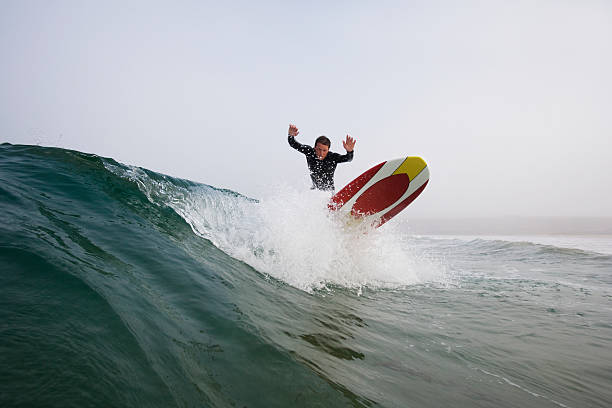
You see it in the lineup, that one surfer who just seems to be operating on a different frequency. The wave doesn’t just wrap around them; it seems to bow down. The turns are so tight they look like a jackknife, a slash of whitewater that paints the face of the swell. The drop is late, almost against reason, a vertical plummet into the belly of the wave. They’re not just surfing. They’re performing a kind of liquid poetry that gets your heart thumping just by watching. That, my friend, is a ripper. The term gets thrown around a lot, from the grom on a foamie to the old salt on a log, but understanding what it truly means to be a ripper is to understand a central tenet of the surfing ethos. It’s not just about the adrenaline or the scores in a contest. It’s about a deep, soulful relationship with the ocean and a relentless, almost obsessive, quest for connection.
First, let’s drop the pretense. A ripper is a skilled surfer, yes, but the word carries a weight that “skilled” just can’t catch. “Skilled” is too clinical, like describing a perfect alaia ride as “adequate.“ A ripper is someone who has graduated from the school of hard knocks, whose feet have calluses from the wax, whose lungs know the sting of a hold-down. They are the ones who have paid their dues. It’s a standard born of the riptides and the reef. A kook can be “good” on a flat day, but a ripper is the one who finds a pocket of juice in the middle of a closeout, threading the needle with a calm that borders on the supernatural. Their barrel is a green room of pure intention, not just a lucky dash to the channel. They are the ones who carve a line so deep it looks like the wave itself is trying to get out of their way.
But the journey to becoming a ripper is not a sprint. It’s a sun-drenched, salt-crusted pilgrimage. It starts with the paddle battle, the endless miles of whitewater that teach a grom to fight back. It’s the hundred wipeouts for every one ride, the frustration of a blown bottom turn, the shame of being pitched by a clean-up set. The true ripper is forged in the fire of failure. They learn to read the ocean’s pulse, to see the subtle bump that’s a double overhead set, to feel the shift in the wind that will either groom the wave to perfection or turn it into a washing machine. They don’t blame the board or the tide. They take full responsibility for the dance. This humility, this respect for the raw power of the Pacific, is the bedrock of their skill. The bravado is for the parking lot. The real work happens in the silent minutes between sets, watching, breathing, waiting.
The culture of the ripper is also a culture of quiet. You won’t often hear a true ripper boasting about their last session. They’ll talk about the wave of the day, a near-miss barrel, a new fin setup that feels like magic. But the talk is never about ego. It’s about the art. The surf lexicon is filled with their creations: the fade, the snap, the cutback that re-enters the power zone. These aren’t just moves; they are the language of a person who is fluent in fluid dynamics. When a ripper says “this stick has got some drive,“ you know they’ve spent hours fine-tuning the rocker, the rail, the foil to get that one specific feeling. It’s a conversation with the shaper that started weeks before the drop-in.
And that’s the subtle beauty of it. The ripper is a student, always. The ocean is the professor, and the waves are the lessons. The endless summer is not just a season; it’s a state of mind. It’s the chase for that perfect swell, that empty peak, that fleeting moment of glide. The ripper’s life is one of pursuit, of packing the van at a moment’s notice, of sleeping in sandy parking lots to be the first one out when the dawn patrol lights up. It’s the sun on your back, the salt in your hair, and the knowledge that the next set could hold the wave of your life. It’s more than a hobby. It’s a way of being, a way of seeing the world through the clean, green glass of a peeling right.
So the next time you see a surfer who just seems to transcend the norm, who makes the impossible look inevitable, you have the word for them. They are a ripper. They are a vessel for the ocean’s energy. They represent the highest expression of the surfer’s soul, a soul that is eternally chasing the horizon, the next tide, and that one, perfect, endless ride. That, in a nutshell, is the spirit of the chase. That is the soul of a ripper.