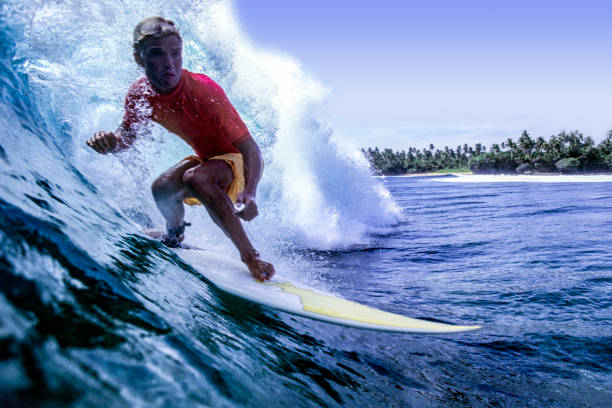
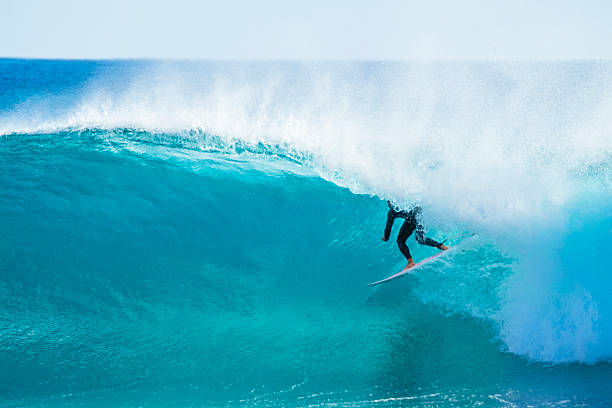
There are waves that make you want to paddle out, and then there are waves that make you check your board, your wetsuit, and your life choices. The Banzai Pipeline, right smack on Oahu’s North Shore, is the poster child for the latter. This ain’t just a wave; it’s a proving ground, a temple of heavy water, and the place where surfers earn their stripes or get slapped so hard they’re drinking sand through a straw for a week. When winter swells roll in from the deep Pacific, Pipeline becomes a grinding beast that breaks over razor-sharp coral just a few feet below the surface. It’s the kind of wave that demands respect, and it doesn’t care about your Instagram following.
The magic of Pipe, as locals call it, lies in its geometry. The reef at Ehukai Beach Park makes the swell pitch up and barrel with violent precision. You get some of the most perfect hollow tubes on Earth. But the barrel is shallow, fast, and explosive. You don’t ride Pipe; you survive it. The drop is steep, the bottom is a flash of coral, and if you blow it, you’re rag-dolled into a washing machine set to death. That’s why the best surfers treat this spot like a high-stakes poker game. One wrong move, and you’re not just out of the hand; you’re out cold.
Surf history is soaked in Pipeline lore. Back in 1961, Phil Edwards and Butch Van Artsdalen started eyeballing this reef, but it wasn’t until the late sixties and early seventies that the spot became the proving ground it is today. Guys like Gerry Lopez, the Ice Man, came through with his single-fin and owned the left at Backdoor. Lopez’s zen approach to the tube inspired a generation to chase the green room. Then you had the North Shore locals, the Hawaiian crew, who guarded their home turf with fierce aloha. The Pipeline wasn’t just a wave; it was a battleground where respect had to be earned in the water. Outsiders who showed up without humility got a quick lesson in Hawaiian big-wave etiquette.
When the Eddie would run at Waimea, Pipeline still had its own contest - the Pipeline Masters, starting in 1971, the Super Bowl of tube riding. Winning it is like a knighthood. Names like Shaun Tomson, Gerry Lopez, and Kelly Slater have taken top honors, but the wave always has the final say. Pipe doesn’t discriminate. It’ll bite a world champ as easily as a grom from the beach. That’s what makes it so legendary. The Masters became a proving ground for tube riding unlike anything else.
The full power of the North Shore shows when a huge swell hits. Buoys scream, the channel packs with boats and photographers, and the shore becomes a carnival of fear. Waves at Pipe can jack to twenty feet, but it’s not the height; it’s the speed. The wave moves like a freight train, and the takeoff is a vertical drop into a spinning vortex. If you’re lucky, you’ll tuck into the barrel and feel absolute silence - the rush of water encasing you, the hiss of the lip overhead. The sound is a low rumble that shakes your chest before you even see the wave. It’s an out-of-body experience surfers chase forever.
But Pipeline has a dark side. Every winter, the reef collects its toll - broken boards, torn ligaments, and even lives. Surfers talk about DPD, Delayed Panic Disorder, because the fear hits you after you’re safe on the sand. Lifeguards are always on standby. Respect is not optional here.
For any surfer, riding Pipe even on a small day is a rite of passage. You’ll sit in the lineup next to legends and locals, feeling the raw energy of the Pacific. The water is warm, the sun is strong, but the ocean is deadly. That’s the package deal. The Banzai Pipeline isn’t just a wave; it’s the soul of surfing’s hairiest edge, a reminder that nature bats last. If you want to play in her house, bring your best game and a whole lotta heart. And when you finally make that drop and feel the wave spit you out, you’ll understand why every surfer on earth dreams of this place.